The Saints of Hogwarts
Feb. 20th, 2019 11:12 pm![[identity profile]](https://www.dreamwidth.org/img/silk/identity/openid.png) mary-j-59.livejournal.com posting in
mary-j-59.livejournal.com posting in ![[community profile]](https://www.dreamwidth.org/img/silk/identity/community.png) deathtocapslock
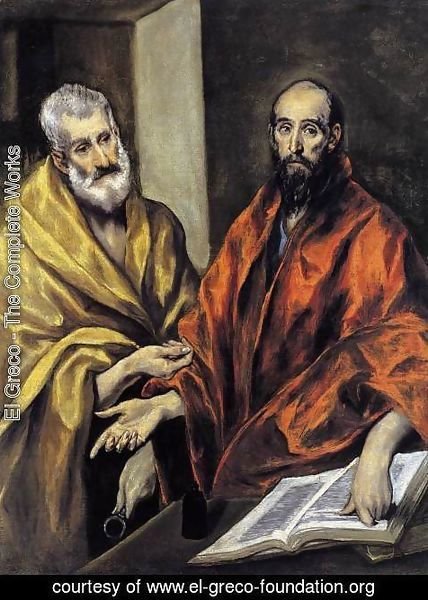
deathtocapslockI know I was not the first person to notice this, but I think it's worth mentioning again. Here are a couple of saints:
http://www.el-greco-foundation.org/thumbnail/70000/70227/mini_normal/Saints-Peter-And-Paul-1605-08.jpg?ts=1459229076
And I just wonder what on earth Rowling was doing with these guys.
Saint Peter, the first Pope, was a simple fisherman. He tended to blurt things out without thinking, and he was made the keeper of the keys of the kingdom. He denied Christ on at least two occasions in the Gospels, once after Jesus was arrested, and again whent the early Christians were being persecuted in Rome. Peter fled the city. The story goes that he met Jesus on the road. Saint Peter asked him, "Where are you going, Lord?"
"I seek Rome," Jesus answered. So Peter turned around and went back. He was arrested, and (eventually) crucified, but he chose to be crucified upside down.
Then there was the young man called Saul of Tarsus. He was zealous for the Jewish faith, such that he persecuted the followers of Christ. When the first martyr, Stephen, was stoned to death, his attackers laid their cloaks at Saul's feet.
Saul, who is to the right in the El Greco painting, was a freeborn Roman citizen. He was converted on the road to Damascus and afterward became as zealous for Christ as he had once been against him. He, too, suffered death. But, as a freeborn Roman, he had a right to be killed by the sword. He was beheaded.
As to their appearance, what's been handed down is that Peter was big and burly, while Paul was a rather slender, wiry type.
So what WAS Rowling doing with these guys?
Hagrid is quite obviously modelled on Saint Peter, while Severus Snape is modelled on Saint Paul. But--
The real men were of different classes. Both were Jewish; both belonged to a subject, occcupied people. But Peter was a commoner while Paul was patrician. Not so with Severus and Hagrid. Hagrid is a commoner, certainly, but so is Severus. Both are half-bloods.
The real men were both saints, both teachers, and both founders of the faith. But the characters in the Potter books? They and their fates are very different.
Hagrid is beloved by Harry. When the Acromantulas carry him off upside down, he somehow survives. He's not crucified, after all.
Severus, on the other hand, is hated by Harry. And he is very nearly beheaded. However, there is no suggestion that he is redeemed.
It's all very frustrating to me, somehow. I can't make out why on earth Rowling so obviously harks back to these two saints when the characters she bases them on are so different in their fates and characters.
Just one more thing. Also during the Passion, when Christ was arrested, one of his followers took a sword and struck out with it. He chopped off the ear of one of the assailants. When the man who picked up the sword is named, his name isn't Paul (as you'd expect, since it was Severus who chopped off the twin's ear during the flight of the seven Potters.). It's Peter.
What on earth do you think Rowling meant by all this? Did she mean nothing at all except, yes, Severus is a good guy? Thoughts?
http://www.el-greco-foundation.org/thumbnail/70000/70227/mini_normal/Saints-Peter-And-Paul-1605-08.jpg?ts=1459229076
And I just wonder what on earth Rowling was doing with these guys.
Saint Peter, the first Pope, was a simple fisherman. He tended to blurt things out without thinking, and he was made the keeper of the keys of the kingdom. He denied Christ on at least two occasions in the Gospels, once after Jesus was arrested, and again whent the early Christians were being persecuted in Rome. Peter fled the city. The story goes that he met Jesus on the road. Saint Peter asked him, "Where are you going, Lord?"
"I seek Rome," Jesus answered. So Peter turned around and went back. He was arrested, and (eventually) crucified, but he chose to be crucified upside down.
Then there was the young man called Saul of Tarsus. He was zealous for the Jewish faith, such that he persecuted the followers of Christ. When the first martyr, Stephen, was stoned to death, his attackers laid their cloaks at Saul's feet.
Saul, who is to the right in the El Greco painting, was a freeborn Roman citizen. He was converted on the road to Damascus and afterward became as zealous for Christ as he had once been against him. He, too, suffered death. But, as a freeborn Roman, he had a right to be killed by the sword. He was beheaded.
As to their appearance, what's been handed down is that Peter was big and burly, while Paul was a rather slender, wiry type.
So what WAS Rowling doing with these guys?
Hagrid is quite obviously modelled on Saint Peter, while Severus Snape is modelled on Saint Paul. But--
The real men were of different classes. Both were Jewish; both belonged to a subject, occcupied people. But Peter was a commoner while Paul was patrician. Not so with Severus and Hagrid. Hagrid is a commoner, certainly, but so is Severus. Both are half-bloods.
The real men were both saints, both teachers, and both founders of the faith. But the characters in the Potter books? They and their fates are very different.
Hagrid is beloved by Harry. When the Acromantulas carry him off upside down, he somehow survives. He's not crucified, after all.
Severus, on the other hand, is hated by Harry. And he is very nearly beheaded. However, there is no suggestion that he is redeemed.
It's all very frustrating to me, somehow. I can't make out why on earth Rowling so obviously harks back to these two saints when the characters she bases them on are so different in their fates and characters.
Just one more thing. Also during the Passion, when Christ was arrested, one of his followers took a sword and struck out with it. He chopped off the ear of one of the assailants. When the man who picked up the sword is named, his name isn't Paul (as you'd expect, since it was Severus who chopped off the twin's ear during the flight of the seven Potters.). It's Peter.
What on earth do you think Rowling meant by all this? Did she mean nothing at all except, yes, Severus is a good guy? Thoughts?


![[personal profile]](https://www.dreamwidth.org/img/silk/identity/user.png)
no subject
Date: 2019-02-21 06:47 am (UTC)What I'd like to know is why she is using catholic imagery and tropes when she's supposedly protestant and certainly uses the doctrine of the "elects" aka Gryffindors as the ~moral~ centre of her story, though I think she goes by images and grudges with nothing thought out behind them: her religion and morals are opportunistic postures; she's both God!Dumbledore and Jesus!Harry and she can do no wrong, or something like that.
Mind you, it's not that I don't like your analyses and essays because I love them, it's just that I think this one is a little off.
Please forgive my barging in, I'm very rarely online and tend to lurk. :)
no subject
Date: 2019-02-22 02:37 am (UTC)Severus Snape, as I pointed out, is equated with both Peter and Paul at different times, but mostly with Paul.
These books are just loaded with Catholic symbolism, just as you say. These symbols are also familiar to Anglicans, and Rowling grew up Anglican. So she'd know them. But what they're doing in her story is another question. Because, really, other than offering a heavy hint as to Snape's loyalties (when he chopped off the twin's ear--I forget which twin it was; George?--I said. Okay. Now I know for sure he's on the side of right.). Starting that rambling sentence over! Other than hinting at Snape's loyalties, these symbols don't seem to serve any purpose in the story.
I really think you're right that "she goes by images and grudges with nothing thought out behind them". It's too bad. When people make such heavy use of symbolism, I expect it to mean something!
no subject
Date: 2019-02-23 09:03 pm (UTC)You're right that it isn't consistent--it's like some bits of Christian symbolism vaguely connected to some bits of her story, so they burbled up wherever something fit, but there's no coherency to it. Maybe some of it fits for certain individual moments in the story (arguable!), but not for the series as a whole. It's more like a grab-bag of "imagery and motifs which appear in many Western literary works" dumped in with the rest of the genre soup.
no subject
Date: 2019-02-24 05:14 am (UTC)Religious symbolism tends to fly over my head unless it's conspicuous. I found it the most evident in the last book. I would've never thought to connect the characters to saints or any sort of catholic figures when reading the earlier books.
I agree with sunnyskywalker that there was no coherency to the Christian symbolism in the story, or at least, the last book. I've mentioned before how JKR's disjointed commentary on certain characters gives me whiplash, especially Dumbledore.
I don't know what the overall message JKR was going for in DH with her religious motifs/tropes. Believe in God!Dumbledore to the very end because he knows best? (Even though he's human, morally grey, and flawed?)
I'm not going to talk too much about Snape or the Slytherins in general because I've ranted an abysmal amount about their depiction. When I read DH for the first time, it made me uncomfortable how all the Slytherin children were scorned in the Battle at Hogwarts by depicting them as selfish cowards. Being a coward is the worst thing to be in JKR's world. Whatever moral message JKR was going for, it struck me as a condemnation of the entire House as a lost cause, full of irredeemable sinners.
Thanks
Date: 2019-02-25 04:28 pm (UTC)no subject
Date: 2019-02-25 04:35 pm (UTC)But really, given the way the books end, given the way the Slytherins are treated, all this symbolism is deeply offensive to me. Really. I don't know if you know this, but there was a very bright little Native American girl, and her mom, who talked about this very subject--the misuse of sacred symbols in Rowling's latest work. It was bad when she was riffing off Catholicism. Doing the same to Native symbols, to me, is almost unforgivable. It's appropriation, and worse.
Oh, well. Rowling really is brilliant, but in the way a mirror is brilliant. It's all surface, isn't it?
no subject
Date: 2019-02-26 04:20 am (UTC)It's frustrating how close the books can come to brilliance and then how dramatically they fall short. If only some of those deeper themes and symbolism could have been even a little more thoughtful and coherent! This is one of the things editing is for!
no subject
Date: 2019-02-26 10:28 am (UTC)I also think JKR's decision to place religious symbolism in her books is the same reasoning as why she chose to implement heavier themes later in the series - she wanted to be taken as a serious writer. Starting by book 5, the books morphed into a darker tone. Religion, racism, politics, grey morality, and so forth were more often featured in her story to make it complex. The potential was there, but she never took it all the way. As you've said, it stayed on the surface level. She played around with complexity to give her writing more somberness, but reverted back to simplicity for whatever reason. Maybe the serious questions about redemption, change, and morality were too uncomfortable for her to fully explore and answer, especially if she was struggling with her own beliefs. Hence, setting up Christian imagery, but not coherently following through with it.
I agree that her use of Native American symbolism was careless. When I read about the creation of Ilvermorny and how the houses apply animals from Native American mythology despite the school being founded by European settlers, I knew that JKR had better luck staying with what she knows: the UK. Playing around with North American history in attempt to broaden her fictional magical world without taking the time to learn about real Native beliefs is appropriation.
The HP books never struck me as progressive or as open-minded as some people praised them to be. I think Rowling wanted to mature with the times and convey progressive views in her world but did so in a clumsy manner. She's an author with a great imagination, interesting ideas, and the ability to create a world full of characters with potential, but something falls short in her writing and leaves the story simplistic.
no subject
Date: 2019-04-28 11:45 am (UTC)no subject
Date: 2019-05-04 02:54 am (UTC)Yes! This! In her interviews, as in her text, Rowling does not come off as open-minded or progressive, but as a middle-of-the-road, rather thoughtlessly PC, neoliberal. In other words, a Tory/Blairite.
And I don't think she has ever apologized for her appropriation of Native myths, has she? These are vital and alive to millions of people to whom she owes an apology. I might well have made the same sorts of mistakes; I do understand, but it would have been better for her not to go there.
no subject
Date: 2019-05-04 02:56 am (UTC)