![[community profile]](https://www.dreamwidth.org/img/silk/identity/community.png)
The Saints of Hogwarts
Feb. 20th, 2019 11:12 pm![[identity profile]](https://www.dreamwidth.org/img/silk/identity/openid.png) mary-j-59.livejournal.com
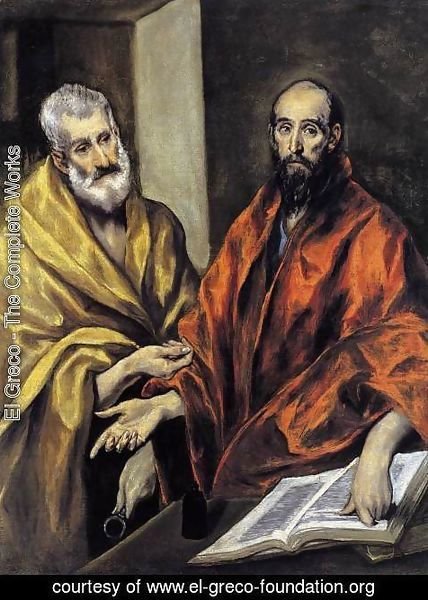
mary-j-59.livejournal.comI know I was not the first person to notice this, but I think it's worth mentioning again. Here are a couple of saints:
http://www.el-greco-foundation.org/thumbnail/70000/70227/mini_normal/Saints-Peter-And-Paul-1605-08.jpg?ts=1459229076
And I just wonder what on earth Rowling was doing with these guys.
Saint Peter, the first Pope, was a simple fisherman. He tended to blurt things out without thinking, and he was made the keeper of the keys of the kingdom. He denied Christ on at least two occasions in the Gospels, once after Jesus was arrested, and again whent the early Christians were being persecuted in Rome. Peter fled the city. The story goes that he met Jesus on the road. Saint Peter asked him, "Where are you going, Lord?"
"I seek Rome," Jesus answered. So Peter turned around and went back. He was arrested, and (eventually) crucified, but he chose to be crucified upside down.
Then there was the young man called Saul of Tarsus. He was zealous for the Jewish faith, such that he persecuted the followers of Christ. When the first martyr, Stephen, was stoned to death, his attackers laid their cloaks at Saul's feet.
Saul, who is to the right in the El Greco painting, was a freeborn Roman citizen. He was converted on the road to Damascus and afterward became as zealous for Christ as he had once been against him. He, too, suffered death. But, as a freeborn Roman, he had a right to be killed by the sword. He was beheaded.
As to their appearance, what's been handed down is that Peter was big and burly, while Paul was a rather slender, wiry type.
So what WAS Rowling doing with these guys?
Hagrid is quite obviously modelled on Saint Peter, while Severus Snape is modelled on Saint Paul. But--
The real men were of different classes. Both were Jewish; both belonged to a subject, occcupied people. But Peter was a commoner while Paul was patrician. Not so with Severus and Hagrid. Hagrid is a commoner, certainly, but so is Severus. Both are half-bloods.
The real men were both saints, both teachers, and both founders of the faith. But the characters in the Potter books? They and their fates are very different.
Hagrid is beloved by Harry. When the Acromantulas carry him off upside down, he somehow survives. He's not crucified, after all.
Severus, on the other hand, is hated by Harry. And he is very nearly beheaded. However, there is no suggestion that he is redeemed.
It's all very frustrating to me, somehow. I can't make out why on earth Rowling so obviously harks back to these two saints when the characters she bases them on are so different in their fates and characters.
Just one more thing. Also during the Passion, when Christ was arrested, one of his followers took a sword and struck out with it. He chopped off the ear of one of the assailants. When the man who picked up the sword is named, his name isn't Paul (as you'd expect, since it was Severus who chopped off the twin's ear during the flight of the seven Potters.). It's Peter.
What on earth do you think Rowling meant by all this? Did she mean nothing at all except, yes, Severus is a good guy? Thoughts?
http://www.el-greco-foundation.org/thumbnail/70000/70227/mini_normal/Saints-Peter-And-Paul-1605-08.jpg?ts=1459229076
And I just wonder what on earth Rowling was doing with these guys.
Saint Peter, the first Pope, was a simple fisherman. He tended to blurt things out without thinking, and he was made the keeper of the keys of the kingdom. He denied Christ on at least two occasions in the Gospels, once after Jesus was arrested, and again whent the early Christians were being persecuted in Rome. Peter fled the city. The story goes that he met Jesus on the road. Saint Peter asked him, "Where are you going, Lord?"
"I seek Rome," Jesus answered. So Peter turned around and went back. He was arrested, and (eventually) crucified, but he chose to be crucified upside down.
Then there was the young man called Saul of Tarsus. He was zealous for the Jewish faith, such that he persecuted the followers of Christ. When the first martyr, Stephen, was stoned to death, his attackers laid their cloaks at Saul's feet.
Saul, who is to the right in the El Greco painting, was a freeborn Roman citizen. He was converted on the road to Damascus and afterward became as zealous for Christ as he had once been against him. He, too, suffered death. But, as a freeborn Roman, he had a right to be killed by the sword. He was beheaded.
As to their appearance, what's been handed down is that Peter was big and burly, while Paul was a rather slender, wiry type.
So what WAS Rowling doing with these guys?
Hagrid is quite obviously modelled on Saint Peter, while Severus Snape is modelled on Saint Paul. But--
The real men were of different classes. Both were Jewish; both belonged to a subject, occcupied people. But Peter was a commoner while Paul was patrician. Not so with Severus and Hagrid. Hagrid is a commoner, certainly, but so is Severus. Both are half-bloods.
The real men were both saints, both teachers, and both founders of the faith. But the characters in the Potter books? They and their fates are very different.
Hagrid is beloved by Harry. When the Acromantulas carry him off upside down, he somehow survives. He's not crucified, after all.
Severus, on the other hand, is hated by Harry. And he is very nearly beheaded. However, there is no suggestion that he is redeemed.
It's all very frustrating to me, somehow. I can't make out why on earth Rowling so obviously harks back to these two saints when the characters she bases them on are so different in their fates and characters.
Just one more thing. Also during the Passion, when Christ was arrested, one of his followers took a sword and struck out with it. He chopped off the ear of one of the assailants. When the man who picked up the sword is named, his name isn't Paul (as you'd expect, since it was Severus who chopped off the twin's ear during the flight of the seven Potters.). It's Peter.
What on earth do you think Rowling meant by all this? Did she mean nothing at all except, yes, Severus is a good guy? Thoughts?


![[personal profile]](https://www.dreamwidth.org/img/silk/identity/user.png)