sunnyskywalker: Voldemort from Goblet of Fire movie; text "Dark Lord of Exposition" (ExpositionMort)
[personal profile] sunnyskywalker
Many readers have wondered why none of the adults who care about Harry confronted the Dursleys during his first five years at Hogwarts. What suddenly made them take action in 1996 when they hadn’t seen a need before? Read more... )
sunnyskywalker: Voldemort from Goblet of Fire movie; text "Dark Lord of Exposition" (ExpositionMort)
[personal profile] sunnyskywalker
A lot of fanon assumes that because Lucius, Severus, and Bellatrix are very important during the second war, they must have been so during the first. Lucius was especially trusted and valued because Voldemort gave him the diary and told him so much about it. Similarly, Bellatrix was exceptionally trusted and important because he told her all about the Horcrux he gave her to guard. Severus was important because he got assigned a special mission at Hogwarts. But does any of that that hold up? Not very well, in my opinion. )
[identity profile] reinalobelia.livejournal.com
Hi, first time poster, long (long, long, long) time lurker. I almost want to apologize for making this post, as it's about one of the most (and yet not enough?!) oft-repeated complaints surrounding DH, namely the handling of the motivations behind one Severus Snape.
Read more... )
[identity profile] mary-j-59.livejournal.com
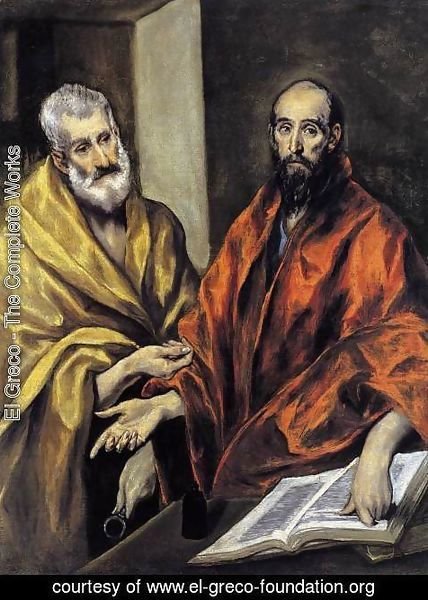
I know I was not the first person to notice this, but I think it's worth mentioning again. Here are a couple of saints:

http://www.el-greco-foundation.org/thumbnail/70000/70227/mini_normal/Saints-Peter-And-Paul-1605-08.jpg?ts=1459229076

And I just wonder what on earth Rowling was doing with these guys.

Saint Peter, the first Pope, was a simple fisherman. He tended to blurt things out without thinking, and he was made the keeper of the keys of the kingdom. He denied Christ on at least two occasions in the Gospels, once after Jesus was arrested, and again whent the early Christians were being persecuted in Rome. Peter fled the city. The story goes that he met Jesus on the road. Saint Peter asked him, "Where are you going, Lord?"

"I seek Rome," Jesus answered. So Peter turned around and went back. He was arrested, and (eventually) crucified, but he chose to be crucified upside down.

Then there was the young man called Saul of Tarsus. He was zealous for the Jewish faith, such that he persecuted the followers of Christ. When the first martyr, Stephen, was stoned to death, his attackers laid their cloaks at Saul's feet.

Saul, who is to the right in the El Greco painting, was a freeborn Roman citizen. He was converted on the road to Damascus and afterward became as zealous for Christ as he had once been against him. He, too, suffered death. But, as a freeborn Roman, he had a right to be killed by the sword. He was beheaded.

As to their appearance, what's been handed down is that Peter was big and burly, while Paul was a rather slender, wiry type.

So what WAS Rowling doing with these guys?

Hagrid is quite obviously modelled on Saint Peter, while Severus Snape is modelled on Saint Paul. But--

The real men were of different classes. Both were Jewish; both belonged to a subject, occcupied people. But Peter was a commoner while Paul was patrician. Not so with Severus and Hagrid. Hagrid is a commoner, certainly, but so is Severus. Both are half-bloods.

The real men were both saints, both teachers, and both founders of the faith. But the characters in the Potter books? They and their fates are very different.

Hagrid is beloved by Harry. When the Acromantulas carry him off upside down, he somehow survives. He's not crucified, after all.

Severus, on the other hand, is hated by Harry. And he is very nearly beheaded. However, there is no suggestion that he is redeemed.

It's all very frustrating to me, somehow. I can't make out why on earth Rowling so obviously harks back to these two saints when the characters she bases them on are so different in their fates and characters.

Just one more thing. Also during the Passion, when Christ was arrested, one of his followers took a sword and struck out with it. He chopped off the ear of one of the assailants. When the man who picked up the sword is named, his name isn't Paul (as you'd expect, since it was Severus who chopped off the twin's ear during the flight of the seven Potters.). It's Peter.

What on earth do you think Rowling meant by all this? Did she mean nothing at all except, yes, Severus is a good guy? Thoughts?

Love in HP

Feb. 6th, 2019 08:20 pm
[identity profile] torchedsong.livejournal.com
Since Valentine's Day is close by, I thought this topic would be fitting to bring up and ramble about until I get it off my chest.

Here comes a few (potentially) silly questions I have about love as a reoccurring and major theme in the HP books: is love a redemptive and saving force? Is it a reflection of our inner nature and morals? Does it make us better or worse than we are? Is it proof we’re capable of good? Or is it simply a nice message to have in a children’s series i.e. love is more powerful than anything?

Read more... )
sunnyskywalker: Young Beru Lars from Attack of the Clones; text "Sunnyskywalker" (Default)
[personal profile] sunnyskywalker
Thanks to torchedsong for bringing up the topic of character complexity (or the destruction thereof). JKR's desperate attempts to force characters that had grown beyond her control back into simpler, Really Good vs. Really Bad boxes in DH always gets me thinking.

Some HP characters I used to love disappointed me so much once I'd processed DH that I lost sympathy for them for a while. JKR excusing some characters’ flaws and not others also makes it tempting to blame her pet characters and dislike them forever more. Now, I prefer a complex cast of characters who might have sympathetic motivations and flaws which inevitably bring them into conflict over what I felt JKR wrote in DH, so I’ve been trying to re-examine the HP books with a view toward finding some sympathy for all the characters, even the really terrible ones. (No luck so far with James. I’m not sure I’ll ever manage that.)

This led me to Prisoner of Azkaban, where Snape is responsible for brewing Lupin’s medication and making sure he takes it. Even Dumbledore ought to have noticed that this is a no-good, horrible, very bad idea. Snape will be freshly reminded of the time Lupin nearly killed him at regular intervals. Lupin will be freshly reminded of the time he nearly killed Snape because his good friend Sirius set him up (and possibly react by trying to minimize it all to avoid a debilitating guilt-spiral), plus will face the anxiety that maybe the guy he bullied for years and nearly killed will poison him in revenge. Why on Earth would anyone set them both up for this? Yes, Snape is one of the few people talented enough to brew Wolfsbane… but Dumbledore is supposed to be a genius at everything magical, and he studied alchemy, which surely has skills that translate to potions. Why can’t he brew the Wolfsbane and deliver it with a twinkle? Even if he can’t, why can’t he deliver it instead of Snape? Forcing them to deal with each other directly over such a fraught subject is guaranteed to make them both suffer.

*headdesk* Probably because that’s the point. This is part of Dumbledore’s war strategy. Snape is probably in on it to some degree—not that it makes it any less miserable for him.Read more... )
[identity profile] torchedsong.livejournal.com
(I've been lurking in this community for a couple of days now, reading posts from way back and enjoying the discussion [and snark]. I know this topic has been done before numerous times, but I hope it's okay for me to offer my thoughts as well.)

It is over a decade later and I am still disenchanted with how Severus Snape was flattened as a character in DH by having everything connect to Lily. I rarely encounter fans of Snape on Tumblr who feel the same way, so I decided to post this here to find other people who can empathize.

From books 1-6, I found Snape to be a fascinating character. He was a mean teacher and a bitter man, but also (seemingly) on the side of the good guys with his own mysterious agenda. Despite his cruel nature, he was presented as capable of protecting and helping those whom he loathed or did not care for. He had a sense of right and wrong when it counted, even while remaining bitter. This unpleasant man left a group of prejudiced and dangerous criminals because even unpleasant people are capable of stepping away from evil. All of this made him an intriguing character full of potential, and I hoped that JKR wouldn’t waste that potential by making everything he’s done be for the Love of a Good Woman that Got Away.
Read more )
[identity profile] fatairuq.livejournal.com

Has anyone started playing the game yet? From what I've seen, it contains a lot of the things we have complained about in the community. The antagonist in the game is from Slytherin, the players are encouraged to break rules, students are put in danger without teachers intervening. Snape is hilarious in it which is the only reason I'm downloading it.

[identity profile] terri-testing.livejournal.com
So, a couple of questions I wanted to toss out about the Heads of Houses.

First, Snape, the Head of Slytherin, seems to be much younger (31 when we and Harry meet him) than the other Heads of House.  But, at (by?) that time he seems to have the support of his students (as well as supporting/defending them).  In particular, in second year we see Draco Malfoy sucking up to him by suggesting his father (who is on the Board of Governors) would support Snape's possible candidacy to be Headmaster.  

On the other hand, someone (Jodel?  Whitehound?  Swythyv? Oneandthetruth?  I'm not remembering at this time) suggested that Snape might have been installed as Head of Slytherin to weaken the house (given his dependence on Dumbledore).  (And that the loss of the Slug Club funnelling fresh talent into the Ministry did fatally weaken it to the point Voldemort found it possible to topple it with one blow.)

So.

Do we have canon how much Snape's house supported him?

Do we have canon when he was actually installed as Head?  I always assumed he replaced Slughorn as Head of Slytherin and Potions Master simultaneously in 1981, but that's an assumption.  So my assumption Snape was to credit for that long string of Slytherin House Cup victories might not be correct.

And... the Board of Governors has something to say about the headmastership.  What about House Heads?  Was Snape, whatever year he was installed as Head of Slytherin House, installed with their approval, against their will, or what?
[identity profile] fatairuq.livejournal.com
I have loved Severus since I first read the Harry Potter books. Before the Snape discourse in Tumblr, I basically felt annoyed at how J K Rowling (JKR from here on) explained his motivations in DH. As someone who has gone through everything he went through except for poverty, I felt that she robbed us off one of the most important representations abuse and bullying survivors ever. You see prior to the Prince's Tale, Severus was angry and bitter even his thirties, he was competent in his line of work as a Professor, Potioneer and spy, he fell in with a fascist cult in order to survive and get ahead in life, and then he redeemed himself. He's everything survivors aren't allowed to be. He is the epitome of Bad Victim. To be Good Victims, we're supposed to forgive those who hurt us, be kind and compassionate to everyone without fail, work in small business or social work because we're not cut out for anything bigger, and while we are expected to help ourselves without support systems, we need someone us to guide us to redemption.
Read more... )
After the discourse which highlighted Severus' association with Lily to a ridiculous level, I hated that chapter even more. I could understand Severus loving Lily for years after her death because she seemed to be the only who gave half a crap about him but enduring torture, hate and even killing someone he cared about just for Lily? It felt so cheap. JKR didn't seem to think a Slytherin could do good and if they do it's for a Gryffindor. She takes this complex character, one of the few in her books, and constantly reduces his reasons to Lily and Severus' bitter, petty tendencies. It was maddening. I spent hours thinking about it and I'm starting to change my mind.

The truth is people don't trust survivors. It's why so many villains are survivors of some kind of violence. They think we're backstabbers and that we are taught to be selfish and violent. In pop culture Bad Victims aren't often loyal to anyone but themselves and if they are it's usually loyalty to another antagonist. Severus Snape is different. The people he is loyal to are considered the best people in canon. Lily is practically a saint and Dumbledore is a deity. Severus' loyalty is steadfast and it helps him do a lot of good. It could potentially be a powerful story on its own.

The problem is I'm not sure. I could be forcing myself to justify what felt like the flattest part of the series. What do you guys think?

Uh...

Mar. 10th, 2017 01:24 pm
[identity profile] star-dragon5.livejournal.com
Even the god Set (or Seth) – a god of chaos, the dry lifeless desert, foreigners, and other things threatening to the Egyptian mindset, and usually falsely mischaracterized today as the “God of Evil” (nonsensical term) because of his role in the slaying of Osiris – was ultimately an upholder of ma’at. Indeed, it is his strength upon which the world’s continued existence depends: Set is the god who stands in the prow of Ra’s solar boat and slays the serpent every night. He is the one god, in fact, who is strong enough to do so, and his scepter is both his personal symbol and a symbol of strength in general. (Yes, I have strong feelings about Set. And another frequently misunderstood myth figure, the Norse god Loki, who I might or might not make reference to sometime later.)

~[livejournal.com profile] condwiramurs, "Indestructible - Part V - The Wheels of Heaven"

Will someone please explain to me what the hell ANY of the above has to do with Severus Snape?

Also, this:

You know, when you think about it, a very, very last-minute gamble by a dying man to undergo Merlin’s initiatory ordeal might have many motivations. As indeed might Tom’s usurpation of that cave.

Some of the legends about Merlin, after all, state that he vanished from the world of men because he was imprisoned through a woman’s wiles. Imprisoned, not killed.

Some legends say, further, that Merlin’s protégé was immortal. "Rex quondum, rexque futurum,"

The legends hint that there may be a fourth route to immortality. Not the Philosopher’s Stone, not the Hallows, not a Horcrux. A mystery known only to Merlin… and perhaps to be revealed to a successor proven worthy by passing the ordeal of the cave.


~[livejournal.com profile] terri_testing, "Albus and the Birdbath"

Nice theory. Too bad there's no evidence that the damn cave was ever anything but a cave. And as usual, terri turns it into an opportunity to bash Albus.
[identity profile] star-dragon5.livejournal.com
You're all familiar with the Draco in Leather Pants and Ron the Death Eater tropes, right?

After seeing the way some--not all--members of this comm treat Snape and Dumbledore, I'm seriously tempted to rename the tropes "Severus in Leather Pants" and "Albus the Death Eater."

I'm sorry if I've offended anyone, but I joined DTCL under the impression it was about analyzing the more problematic parts of the HP books, not about glorifying characters you like/bashing characters you don't like. It looks like I was wrong.
[identity profile] star-dragon5.livejournal.com
Hello, all! Nice to meet you. This is my first post, so please be nice to me.

Read more... )
[identity profile] terri-testing.livejournal.com
I posted this on Snapedom in 2008 or so; my apologies to those who have already read it.

A comparison of Pride and Prejudice and JKR’s romances between James/ Lily and Severus/Lily.
Read more... )
[identity profile] condwiramurs.livejournal.com
I promise I'm still chipping away at Indestructible - I'm just in the middle of a frantic effort to complete my dissertation draft before the end of the semester. I should have another Indestructible piece up over the holidays though. Thanks for being patient!

Until then, I have a little question to toss out for consideration. It's been occupying my mind for a bit.

Question: Why did Voldemort believe that it was necessary to kill to gain the Wand's mastery?

Because he, of all people, should have known that it wasn't. If it were true, Albus Dumbledore would never have had it.

And he did believe, quite firmly, that Albus did.

Read more... )
sunnyskywalker: Young Beru Lars from Attack of the Clones; text "Sunnyskywalker" (Default)
[personal profile] sunnyskywalker
There really is nothing like re-reading these books while looking from the adult characters' perspectives. Harry's first Thursday back at school in PoA is an interesting case.Nothing suspicious at all here. Move along. )
[identity profile] sweettalkeress.livejournal.com
This is an idea that came to me as I was tearing apart a children's book for another comm.

We all know that it's common in the Harry Potter fandom to portray Snape as mean, morally-degenerate, creepy, cowardly, and pretty much any other negative you can come up with. We on this comm have also spent large amounts of time debunking these assertions, insisting that actually, he's not as bad as he's commonly made out to be.

Here's the thing, though: even if you DID accept that Snape was just that nasty and evil and horrible, that's not his fault--it's the fault of the series. And it doesn't actually paint the series in an especially good light, because it implies that teachers who you don't get along with must automatically be evil or morally backwards. Remember: Harry takes an extreme dislike to Snape from their first meeting, just because Snape was generically snide and intimidating to him. It's one thing for Harry to dislike a teacher, because that happens to the best of us (particularly at the age Harry is). But to portray the teacher as evil because of it?

But that is pretty much the trend in the series. Teachers Harry likes, or who are nice to him, are generally portrayed as heroes or at least reasonably pleasant, whereas those Harry takes a disliking to are nearly always presented as villains: Lockhart, Umbridge, etc. And even when they're not (see, for instance, Trelawney and arguably Slughorn), they're generally treated as rather pathetic, so Harry doesn't have to take them very seriously. The overarching pattern this creates implies that if you don't get along with a teacher it's because that teacher is evil or morally weak-willed, or that it's generally all the teacher's fault that they're not bending over backwards to please you. And while you could argue that this is all the Harry filter, it's never really challenged at any point in the story.

Now, I am all for the notion that teachers should look after the well-being of their students; but the fact of the matter is, students can't always expect that to happen. It's great when it does, but sooner or later every student comes upon a teacher who for whatever reason doesn't click with them, either because that particular teaching style just doesn't work with that particular student, or the institution is corrupt, or the teacher is careless. I know it's happened to me a couple times over. Some of the teachers I've had bad experiences with were careless, but I wouldn't say I thought any of them were evil.

And remember: this is a series that targets children and young teenagers. It doesn't do them any favors to be presenting them with a narrative that states that any teacher they don't get along with is evil. The notion that Snape must be a horrible person suffering from trauma and acting out of some misplaced selfish desire is a testament to the story's inability to portray anything Harry doesn't like in a positive or even a neutral light, not a convincing portrayal of a disagreeable character (and I have many, MANY convincing potrayals of disagreeable characters that I could use as a baseline).
sunnyskywalker: Young Beru Lars from Attack of the Clones; text "Sunnyskywalker" (Default)
[personal profile] sunnyskywalker
I was re-reading some old DTCL posts, and started wondering about prophecies. Specifically, about what a young, Dark Arts-curious wizard might know--or believe--about how they work.

Divination class, as we see, teachings more indirect predictive methods, such as reading tea leaves and cystal-gazing. Actively channeling... something... to deliver a prophecy isn't taught as far as we know, and likely can't be. Moreover, that particular method seems to be rather obscure. An official Mystery, in fact.

But there are literary depictions of prophecies. And both Shakespeare and Sophocles lived before the Statute of Secrecy, and their works might be find in wizarding libraries regardless of their authors' actual magical abilities or lack thereof. Their depictions of how prophecies usually work may have been based on fact. At least in part.

Would a geeky young wizard combing through every reference he could find to the Dark Arts read Macbeth and Oedipus the King, one wonders? As part of being thorough? And wonder if, perhaps, trying to prevent a prophecy from coming true really will not only be futile, but might even be the very means by which the prophecy will come to pass? Or at least, the attempt could make the prophecy come to pass sooner than it otherwise would have?

Hypothetically, if such a young wizard overheard part of a prophecy while trying to apply for a job, on his terrifying new master's orders--perhaps with some vague hope of using the opportunity to switch sides, but scared off by the opposition's disdain--would he at least have reason to hope that delivering said prophecy to the terrifying master would actually be a way to strike a blow? A desperate hope, for desperate circumstances? (He'd surely noticed by then how, erm, suboptimal the working conditions under Voldemort were.)

When Severus told Voldemort that a prophesied enemy could defeat him, what exactly did he think might happen should Voldemort respond by trying to kill that enemy?

Very possibly, something more than just that enemy getting AK'd.

Very possibly, the same thing Dumbledore thought might happen: Voldemort would be arrogant enough to think he could outwit a prophecy, and would destroy himself in trying to prevent it.

Then Severus and all his friends could put that nightmare behind them, without having to risk their lives and their families (like, say, the expected Baby Malfoy). Whew! Brave, but saving their necks if possible.

How unfortunate that this turned out to mean Sev's childhood best friend would die in the process! But then, he should have known better. Trying to manipulate a prophecy is liable to rebound on one, after all. Yet another reason for him to wish he had died, afterward.

If he'd just kept his mouth shut, might Harry have been born in the wee hours of the morning of August 1?
[identity profile] condwiramurs.livejournal.com
In poking around more while researching stuff for my coming discussion of Severus and Voldemort for Indestructible, I discovered a curious little fact that seems fitting.

In "Indestructible Intermezzo II - Etymological Excursus," I noted that:

"Our poison synonym, ‘toxic,’ on the other hand, derives ultimately from the Greek word for bow, toxon: the term toxicon pharmakon referred to the poison smeared on arrows, and was borrowed into Latin as toxicum, ‘poison.’ Meanwhile the probably-Scythian word for bow that entered Greek as toxon was also borrowed directly into Latin as taxus, the Latin word for ‘yew.’ A tree long associated with both death and resurrection, and from whose wood, of course, Voldemort got his wand."

And today, while researching the yew tree, I found an unexpected connection back to Severus.

All species of yew tree are known to contain varieties of a highly toxic class of alkaloids called taxanes. Every part of the tree other than the flesh of the red berry-like arils contains these toxins, including the seeds, wood, and leaves. Though the birds who eat the arils and spread the seeds are generally unable to break down the seeds and be affected by the poison, and larvae of a few species of moth and butterfly will eat yew foliage, to most animals consuming yew is fatally poisonous. Human beings consuming yew 'berries' without removing the seeds have died, and cattle and horses have been found dead near yew trees after trying to eat the leaves.

There does, however, seem to be an exception to this rule. Deer are able to break down the toxin, and so will eat the leaves of yew trees. Indeed, they graze so freely on yew that in the wild yew trees are commonly found only on steep slopes inaccessible to deer.

Apparently deer can eat death and live.

You can't make this stuff up.

Profile

deathtocapslock: (Default)
death to capslock

September 2025

S M T W T F S
 1 23456
78910111213
14151617181920
21222324252627
282930    

Syndicate

RSS Atom

Most Popular Tags

Style Credit

Expand Cut Tags

No cut tags
Page generated May. 28th, 2026 12:08 am
Powered by Dreamwidth Studios