[identity profile] mary-j-59.livejournal.com
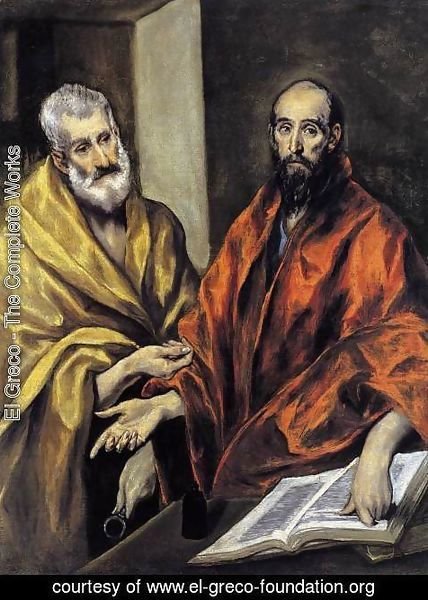
I know I was not the first person to notice this, but I think it's worth mentioning again. Here are a couple of saints:

http://www.el-greco-foundation.org/thumbnail/70000/70227/mini_normal/Saints-Peter-And-Paul-1605-08.jpg?ts=1459229076

And I just wonder what on earth Rowling was doing with these guys.

Saint Peter, the first Pope, was a simple fisherman. He tended to blurt things out without thinking, and he was made the keeper of the keys of the kingdom. He denied Christ on at least two occasions in the Gospels, once after Jesus was arrested, and again whent the early Christians were being persecuted in Rome. Peter fled the city. The story goes that he met Jesus on the road. Saint Peter asked him, "Where are you going, Lord?"

"I seek Rome," Jesus answered. So Peter turned around and went back. He was arrested, and (eventually) crucified, but he chose to be crucified upside down.

Then there was the young man called Saul of Tarsus. He was zealous for the Jewish faith, such that he persecuted the followers of Christ. When the first martyr, Stephen, was stoned to death, his attackers laid their cloaks at Saul's feet.

Saul, who is to the right in the El Greco painting, was a freeborn Roman citizen. He was converted on the road to Damascus and afterward became as zealous for Christ as he had once been against him. He, too, suffered death. But, as a freeborn Roman, he had a right to be killed by the sword. He was beheaded.

As to their appearance, what's been handed down is that Peter was big and burly, while Paul was a rather slender, wiry type.

So what WAS Rowling doing with these guys?

Hagrid is quite obviously modelled on Saint Peter, while Severus Snape is modelled on Saint Paul. But--

The real men were of different classes. Both were Jewish; both belonged to a subject, occcupied people. But Peter was a commoner while Paul was patrician. Not so with Severus and Hagrid. Hagrid is a commoner, certainly, but so is Severus. Both are half-bloods.

The real men were both saints, both teachers, and both founders of the faith. But the characters in the Potter books? They and their fates are very different.

Hagrid is beloved by Harry. When the Acromantulas carry him off upside down, he somehow survives. He's not crucified, after all.

Severus, on the other hand, is hated by Harry. And he is very nearly beheaded. However, there is no suggestion that he is redeemed.

It's all very frustrating to me, somehow. I can't make out why on earth Rowling so obviously harks back to these two saints when the characters she bases them on are so different in their fates and characters.

Just one more thing. Also during the Passion, when Christ was arrested, one of his followers took a sword and struck out with it. He chopped off the ear of one of the assailants. When the man who picked up the sword is named, his name isn't Paul (as you'd expect, since it was Severus who chopped off the twin's ear during the flight of the seven Potters.). It's Peter.

What on earth do you think Rowling meant by all this? Did she mean nothing at all except, yes, Severus is a good guy? Thoughts?
[identity profile] mary-j-59.livejournal.com
Hi, everyone! I do need to chime in on the excellent post on feminsim below--but I just wanted to point out another wildly illogical facet of these books.

I wasn't the first person to notice this, by a long shot. I think Terri said something about it (more than once) and so did Cardigrl, back when she was still on livejournal. But it's worth pointing out again.

Consider that you are a child with--shall we say, unusual talents? Consider that, as scared as you and those around you might be by those talents, you bring them intact to your eleventh birthday. Then you find out you're a wizard.

Rather than rejecting the message, you enter a brand-new world. Can you imagine how that would feel? I know, I know: we were supposed to experience this along with Harry, but he was not actually a Muggleborn, and he did have faint memories (shown in his dreams) of the wizarding world. His home life was also so dreadful (even if played for laughs) that learning that he was special, privileged, talented, and so on had to seem like an escape.

But picture an actual Muggleborn boy or girl entering the wizarding world for the first time. Picture Hermione, for example. Why on earth wasn't she in Slytherin house, if the Slytherins are supposed to be goal-oriented and ambitious? Is there anyone in canon more ambitious than Hermione?

If the wizarding world were logical, far from being the hotbed of purebloods, Slytherin house should have a higher than average percentage of Muggleborns and half-bloods. It should also have a higher than average percentage of working-class kids like young Severus. Instead, Rowling gives us the racist house full of rich people and their retainers. Which makes no kind of sense. In a logical world, as Cardigrl pointed out so many years ago, the racist house full of establishment types would be--

(drumroll)

Gryffindor!
[identity profile] mary-j-59.livejournal.com
Not sure quite what to call this - it's a comment I made on an earlier thread, where it was pretty deeply buried. I'm posting it as a separate comment because it's something I feel pretty strongly about.

Yes, I know - this is a sporking community. We are making fun of the Harry Potter books, and, at times, some of us can get quite irate in our discussions. But - please, please, can we refrain from getting irate towards J.K. Rowling?

Here's what I mean: I'm really not comfortable discussing the character of an actual human being just because I find her books frustrating. I'm a bit of a structuralist. The author is dead once a book has been published, and that cuts two ways. The author is no more privileged in his/her interpretation than any other reader, because the work belongs to the readers now. And there are limits to what we can extrapolate about an author's belief, personality, etc, based on the work s/he has written.

As angry as I get at the awful, mixed messages in these books, I think we must never forget that a real, vulnerable human being wrote them. It isn't right or fair to trash her while trashing the books. (Though I like to think we're not trashing them, but subjecting them to rigorous criticism!) And I'm really not comfortable with speculating about her family life and personality based on the words she's written. Though I do believe all real art is "true" in a deep sense, and reveals the heart of its creator, I still think the art has, and must have, its own validity. You see what I mean?

I hope to be a published author one day. Though I neither want nor expect Rowling's level of fame, I wouldn't like it if anyone psycho-analyzed me on the basis of my stories. I don't think any of us would - and many of us do some type of creative work. Would we like to be called "stupid cows" because a reader found our work stupid? The person is not the work.

So I think it's fine to discuss the image of God in Rowling's stories. I think it's fine to question the heavy use of Christian symbolism given the non-Christian content of the stories. Heck, I've done this myself, repeatedly! It's fine to discuss the mixed messages about race, bullying, authority figures, and so much more. But I'd rather not discuss the psychology and personal life of the woman who wrote the stories. J.K. Rowling is a woman trying to write, and raise a family, and live, in this real world. We shouldn't forget that, no matter how angry her books make us.
[identity profile] mary-j-59.livejournal.com
A friend just loaned me her copies of Jeeves and Wooster, and my sister and I watched this one last week. We couldn't stop laughing! But - note the symbol in the background? WHY is Harry wandering around with the symbol of the English fascists on his forehead? It really doesn't make sense to me.
[identity profile] mary-j-59.livejournal.com
From 2007 onwards, we have, via DH (that disastrous book) and interviews, discovered the following things:

1. The Death Eaters were right. According to Rowling, there are no "Muggleborns". Every Witch or Wizard born to normal parents is a throwback to a magical ancestor. Yes, she really said that!

2. All Wizards seem to feel themselves superior to normal people. Even good-hearted types like Arthur Weasely show themselves extremely prejudiced toward non-magical human beings, as well as extremely ignorant. But-

3. I am no expert on magical history - like Harry, I missed any hints of a coherent backstory that might have been in the books. But I do get the impression that, in addition to being prejudiced, magical people might fear ordinary human beings. Perhaps the persecutions shown as laughable in Harry's textbook were actually quite serious?

4. Young Tom Riddle was fearful of being locked up in an asylum.

5. Young Gellert Grindelwald and Albus Dumbledore aspired to rule over Muggles and Muggleborns.

6. Young Regulus believed Voldemort's agenda was to overthrow the stature of secrecy and have wizards take their rightful place as the lords of creation.

7. And then there's the way Dumbledore chose to raise Harry.

Where I'm going with all this? It's seemed to me for awhile now that the Death Eaters might have a point. What if every Dark Lord in the Wizarding World was either a Muggleborn or a Muggle-raised half-blood? What if Dumbledore was actually trying to create a new Dark Lord?

Think about it. Given what we see of Tommy's, Sev's, and Harry's experiences, magical children have a very hard time in the normal world. In self defense, they may well come up with grandiose theories about their specialness. And, like all magical children, they will lash out with magic at times of high stress. The future Dark Lords among them will control magic early, cling hard to their specialness, and learn contempt, as well as fear, for the normal people who don't and cant' understand them and cant' do magic, either. By the time such a child is 11, he may well be quite powerful magically and morally and emotionally quite messed up.

Thoughts?
[identity profile] mary-j-59.livejournal.com
Hi, everyone! I just posted a brief essay/query on Snapedom. Tried to crosspost here, but for some reason the link didn't copy. If you go to Snapedom on insane journal and look under today's date, you should find it.
[identity profile] mary-j-59.livejournal.com
Hi, everyone! I hope this doesn't get flagged as spam: the folks at Ferretbrain posted a link to a tumblr called Reviewing Rowling. The reviews are a bit harsh - I truly don't think Rowling's grammar is that bad - but the reviewer talks sense about Harry's lack of normal affect and Petunia and Vernon's very normal and sympathetic desire to protect their son. Here's the link:

http://reviewingrowling.tumblr.com/
[identity profile] mary-j-59.livejournal.com
Okay - I confess; I joined Pottermore, out of sheer curiosity. I want to know if, by any strange chance, I will sort to Slytherin, and also what sort of wand I get. Still, some things struck me at once (I've spent about 20 minutes exploring the first chapter):

When describing Number 4, Privet Drive, Rowling said that she chose the number four because she disliked that number, finding it hard and unforgiving. I believe those were the exact words! Do you suppose that feeling is limited to the number four, or might it extend to other numbers?

On a more serious note, she based the look and floorplan of the house on that of a house she lived in herself - and got wierded out because, without discussing it with her, the filmmakers got the floorplan exactly right.

And - this is fascinating! - she had to argue with the publishers, who wanted to convert all the British measurements into metric ones. She also said that Wizards can do complex calculations magically. Can they, really? Then why did we never see them doing this?

Oh, dear. Maths.

But I'm very glad that she talked the publishers into keeping the old fashioned measurements. Can you imagine a metric Wizarding World? I can't.
[identity profile] mary-j-59.livejournal.com
I do feel uncomfortable when we start speculating about J.K. Rowling, the person. OTOH, I also think it's perfectly okay to look hard at the way she presents emotional, as well as moral, issues in her text. And nobody has taken a harder look, with funnier results, than starcrossedgirl! Look here:


http://starcrossedgirl.livejournal.com/322471.html#cutid1
[identity profile] mary-j-59.livejournal.com
This quote was in our advent bulletin, and it struck me very strongly.
There are no ordinary people. You have never talked to a mere mortal. Nations, cultures, arts, civilizations – these are mortal, and their life is to ours as the life of a gnat. Read more... )
[identity profile] mary-j-59.livejournal.com
In the discussion about "The Centaur and the Sneak", Dracasdiablo made a very interesting point. She stated that Marietta was a bad friend to Cho. After thinking about this for a while, I have to admit that I actually agree. The quotes that follow will, I hope, make clear why I think this. Read more... )
[identity profile] mary-j-59.livejournal.com
Hi, everyone. This will be quite short, but something sunnyskywalker said in a previous discussion rang bells with me. What if these books aren't quite what we think they are?

Read more... )

Profile

deathtocapslock: (Default)
death to capslock

September 2025

S M T W T F S
 1 23456
78910111213
14151617181920
21222324252627
282930    

Syndicate

RSS Atom

Most Popular Tags

Style Credit

Expand Cut Tags

No cut tags
Page generated Apr. 6th, 2026 06:18 am
Powered by Dreamwidth Studios